
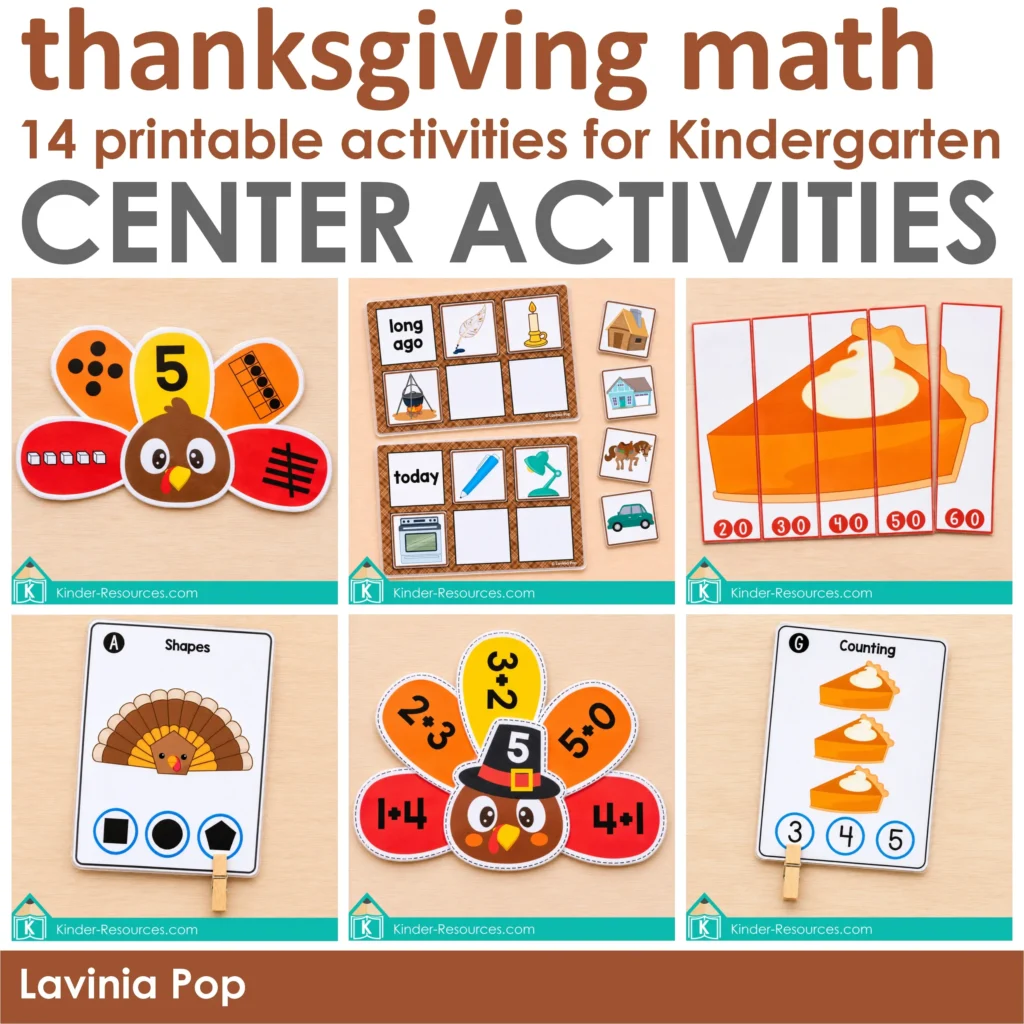
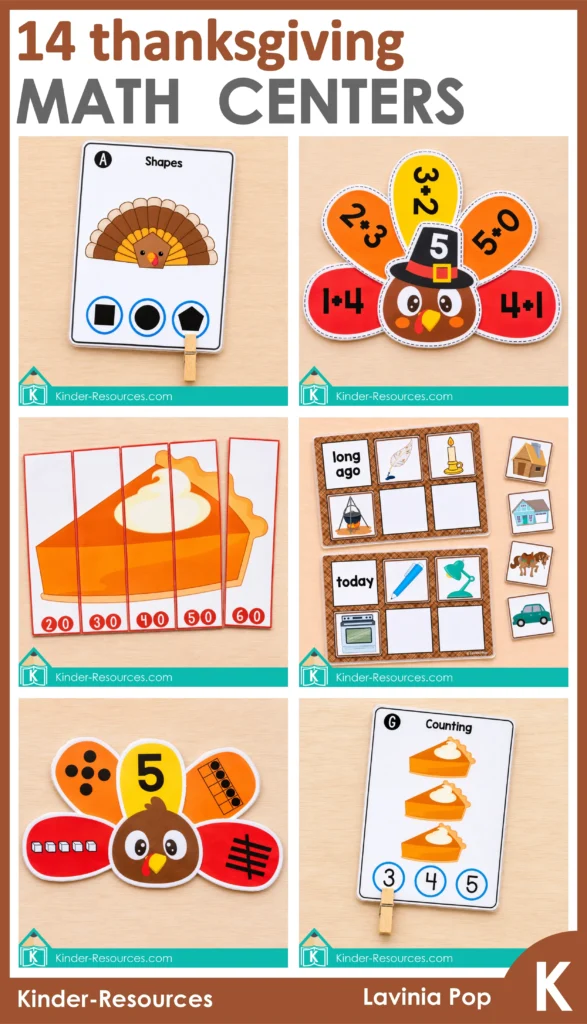
Bring a Thanksgiving theme to your November math centers with turkey number games, counting cards, picture patterns, and simple measuring activities! I created these Thanksgiving Math Centers for Kindergarten to give children hands-on practice with early math skills using materials you can prepare and use again.
The complete packet includes 14 printable activities, illustrated “I can” cards, storage labels, and matching recording pages. Choose centers for small-group instruction, morning tubs, partner work, or independent practice after introducing each activity.
Free Thanksgiving Math Centers Sample
Would you like to try some of the activities first? Download the free sample below. It includes selected counting, missing-number, comparing, graphing, and other activity pages from the packet.
The activity photos in this post feature materials from the complete packet, including the matching recording pages. You’ll find the purchase link near the end.


Preparing Your Thanksgiving Math Centers
Print, laminate, and cut out the center materials you plan to use. Keep each activity in a labeled bag, envelope, or small container with its matching “I can” card. Photocopy the recording pages as needed.
Depending on the activity, you’ll also need clothespins, dry-erase markers, pencils, crayons, or counters. The turkey measuring strips are included in the packet.
Introduce each center before children use it independently. Demonstrate how to use the materials, check an answer, and complete the corresponding part of the recording page. Starting with a small selection of cards makes it easier to learn the routine.


Thanksgiving Math Centers: Counting and Number Sense Activities
Thanksgiving Count and Clip Cards
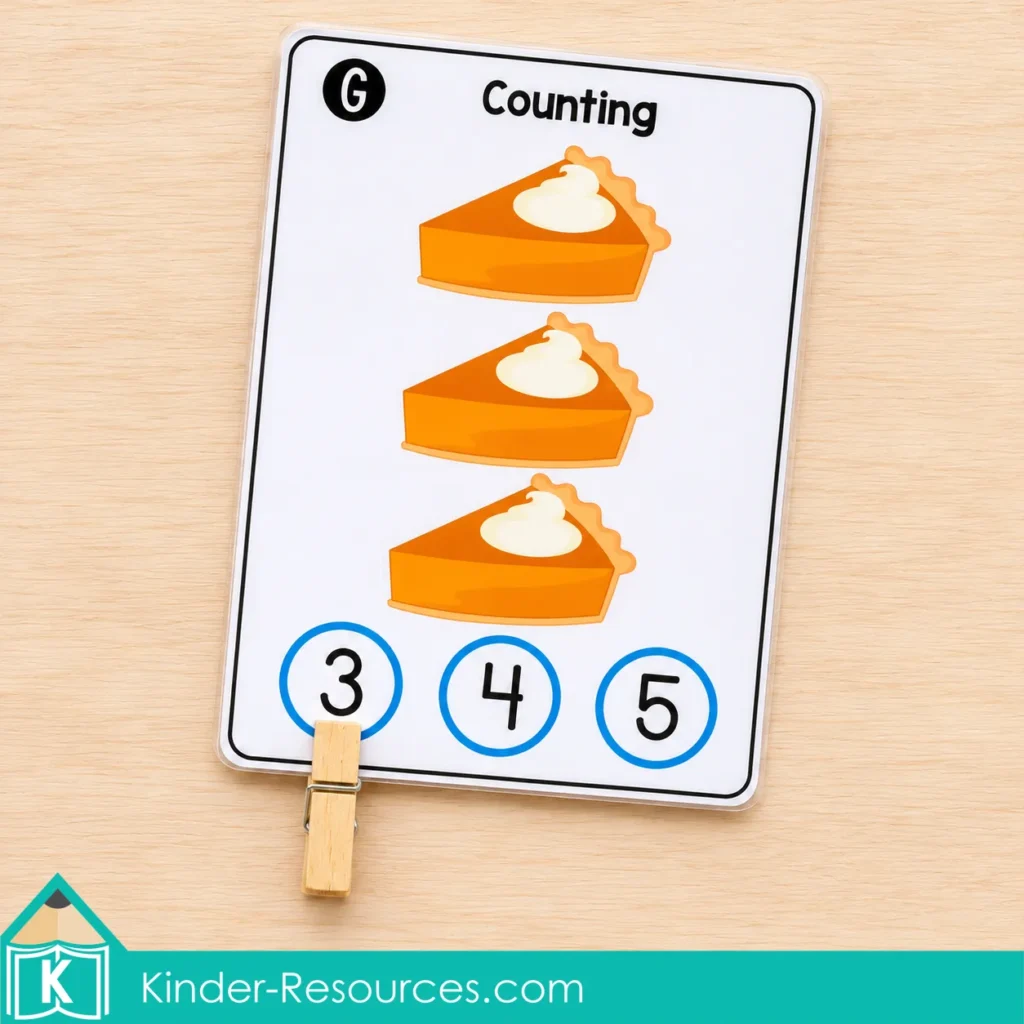
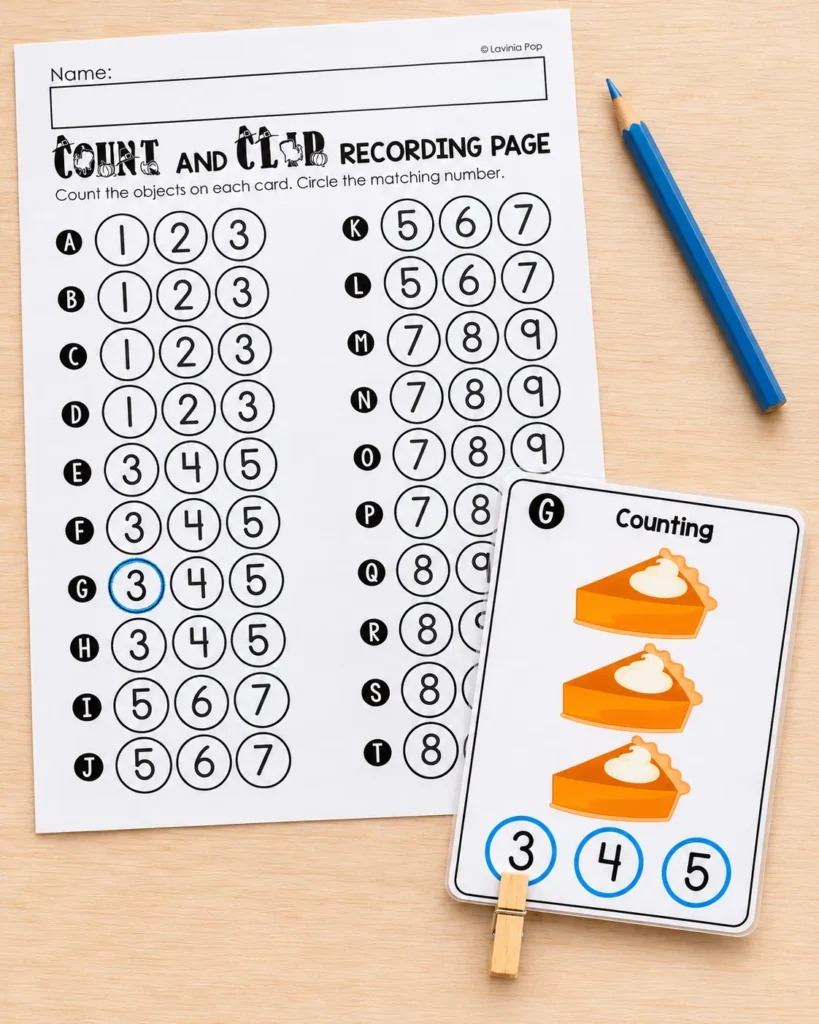
Children count the objects on a card and clip a clothespin beside the matching numeral. Encourage them to touch or point to each picture once as they count.
On the recording page, children find the matching card letter and circle their answer. The pie example gives them three objects to count and the numerals 3, 4, and 5 to choose from.
Turkey Missing Numbers
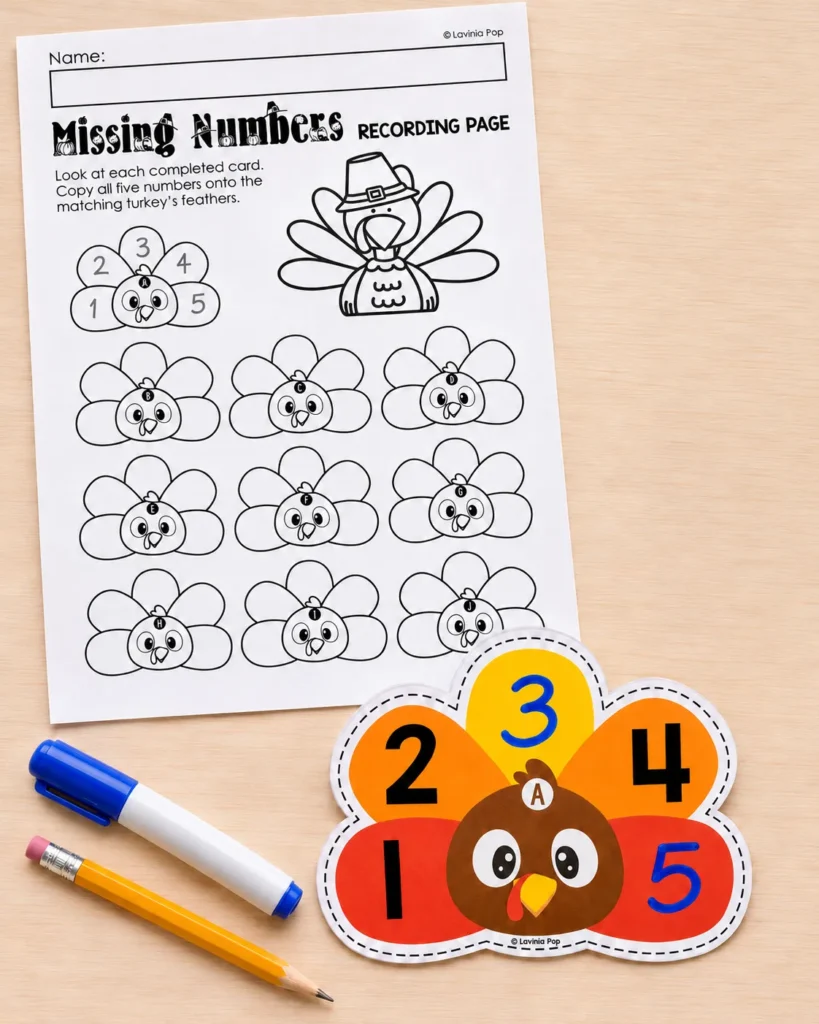
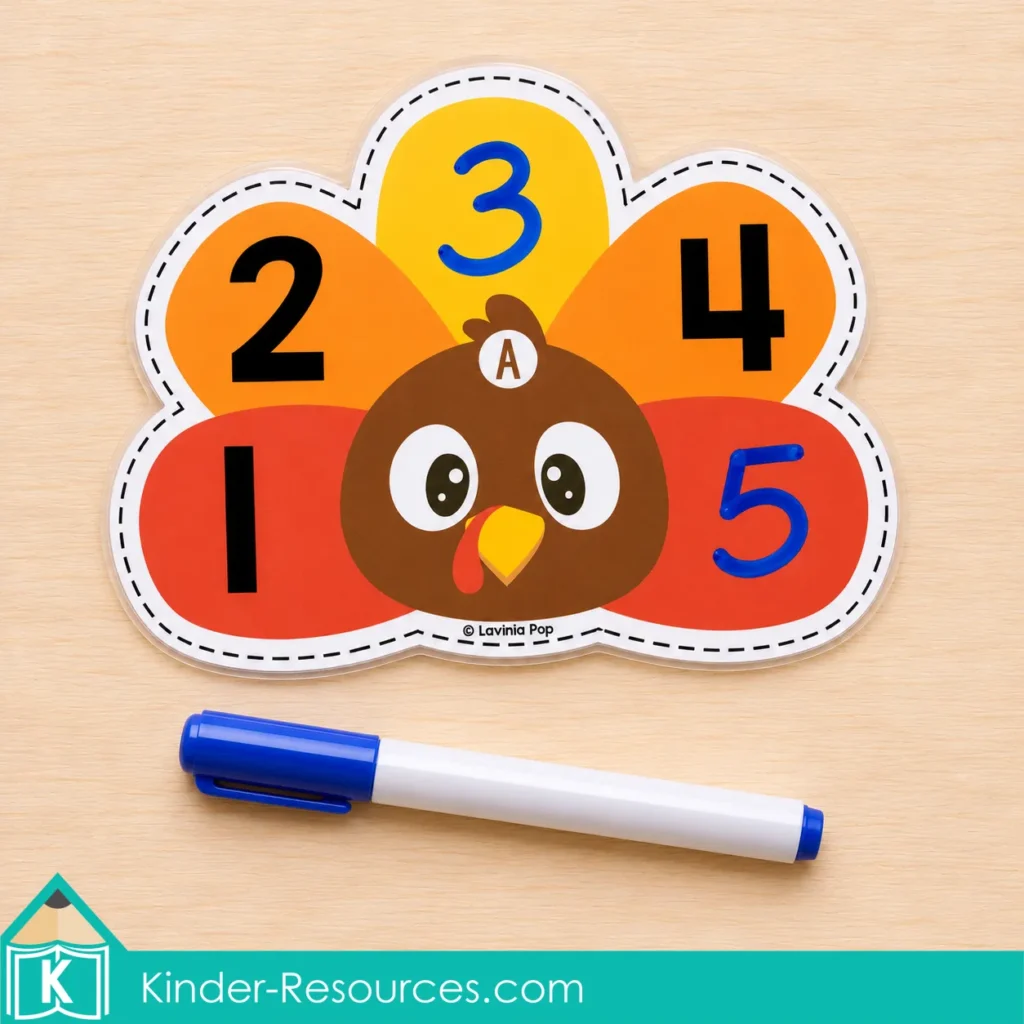
Children read the numbers already printed on the turkey’s feathers and write the missing numbers with a dry-erase marker. They can count forward or backward from a number they know to work out what belongs in each space.
The recording pages provide another opportunity to complete the number sequences. In the example pictured, children fill in 3 and 5 to complete the sequence from 1 to 5.
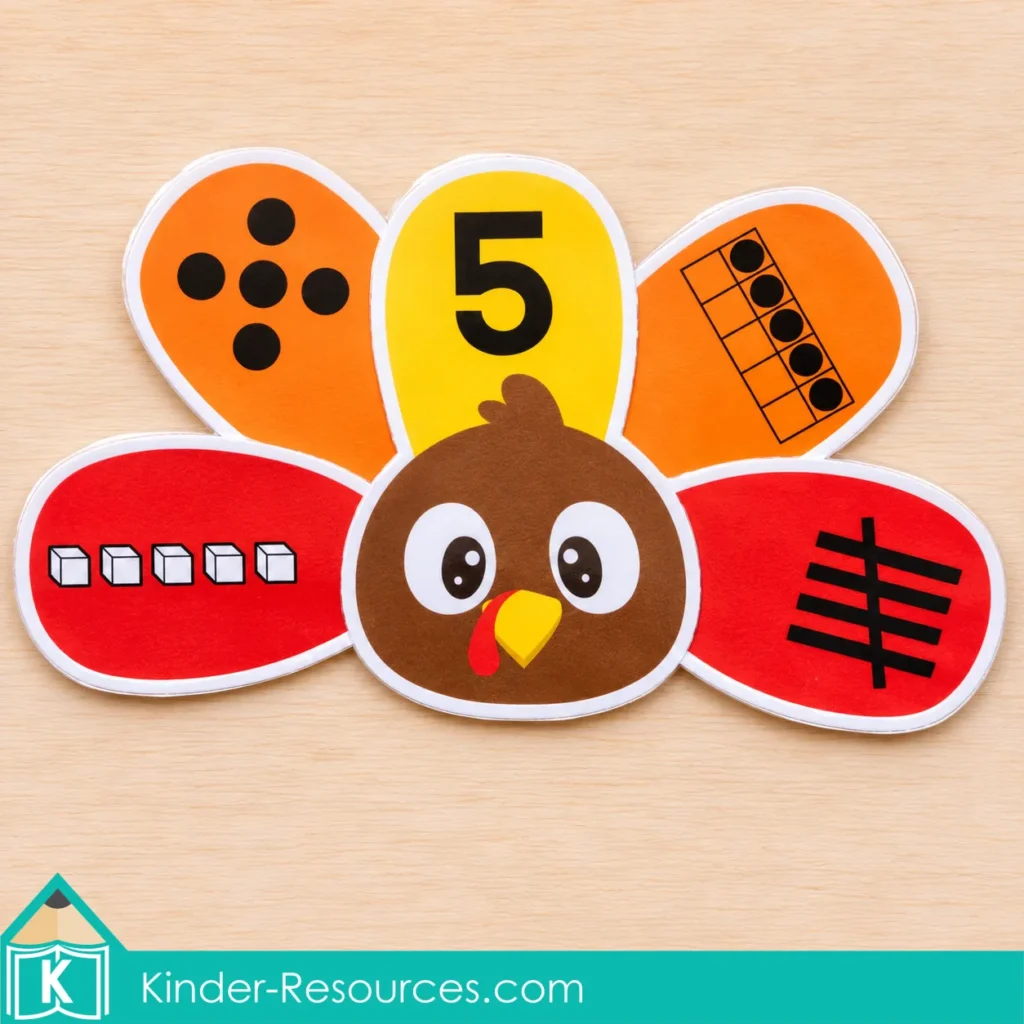
Turkey Number Match
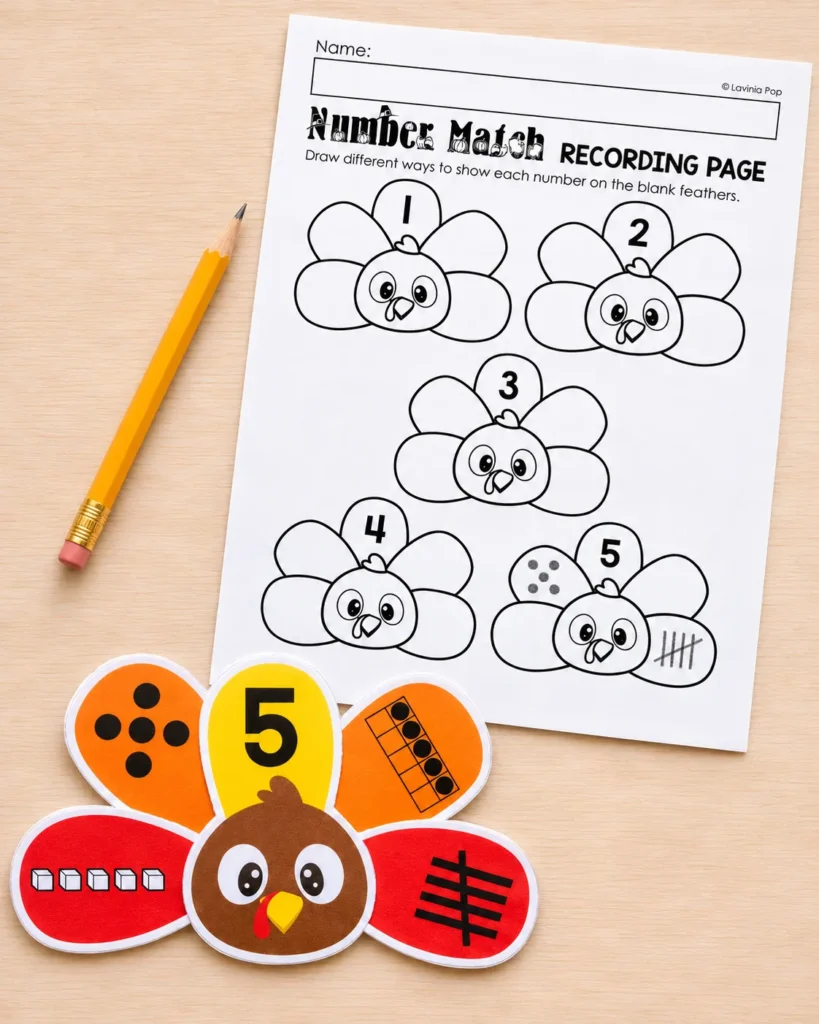
These turkeys help children connect numerals with different ways of representing a quantity. Children match feathers with dot patterns, ten frames, cubes, and tally marks to the turkey showing the same number.
On the recording page, they draw representations of each number on the turkey feathers. You can begin with a few numbers and add more turkeys as children become confident.
Thanksgiving Math Centers: Comparing Groups and Graphing
Which Group Has More?
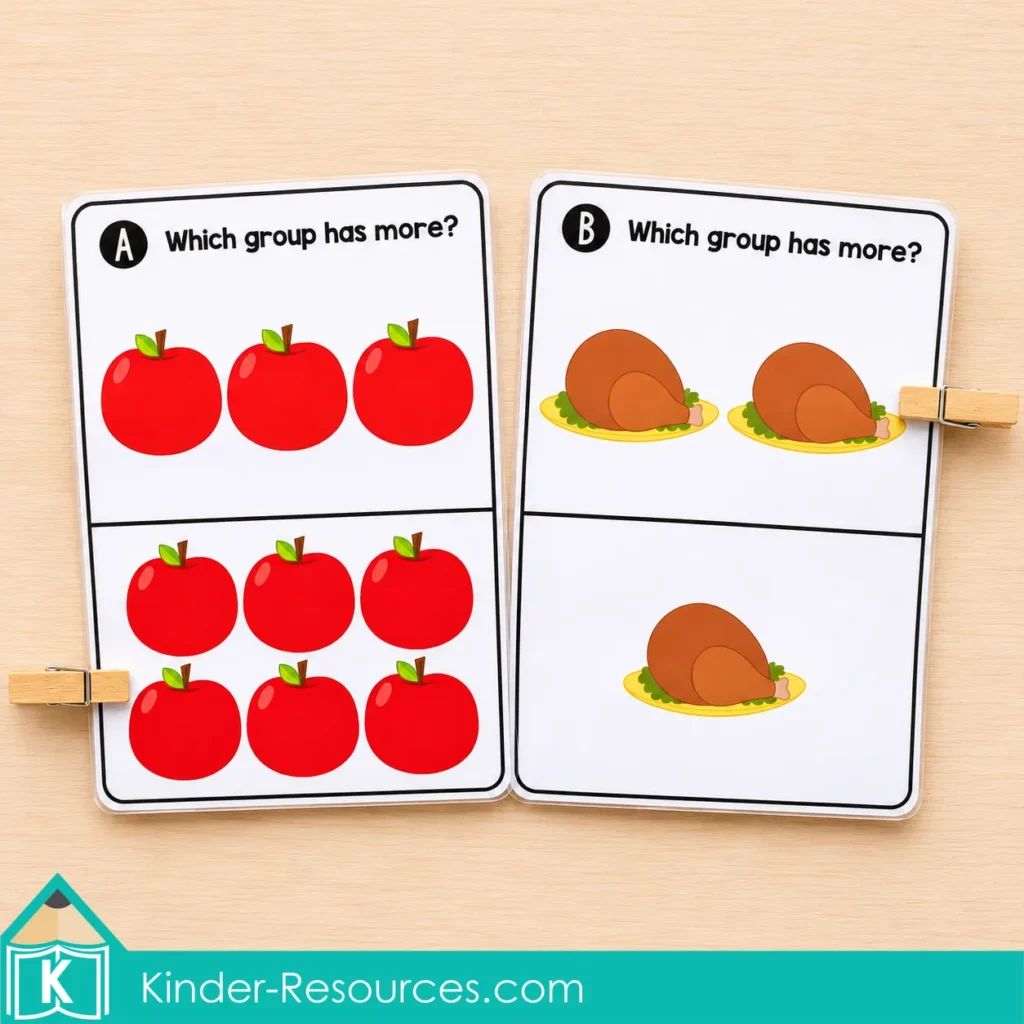
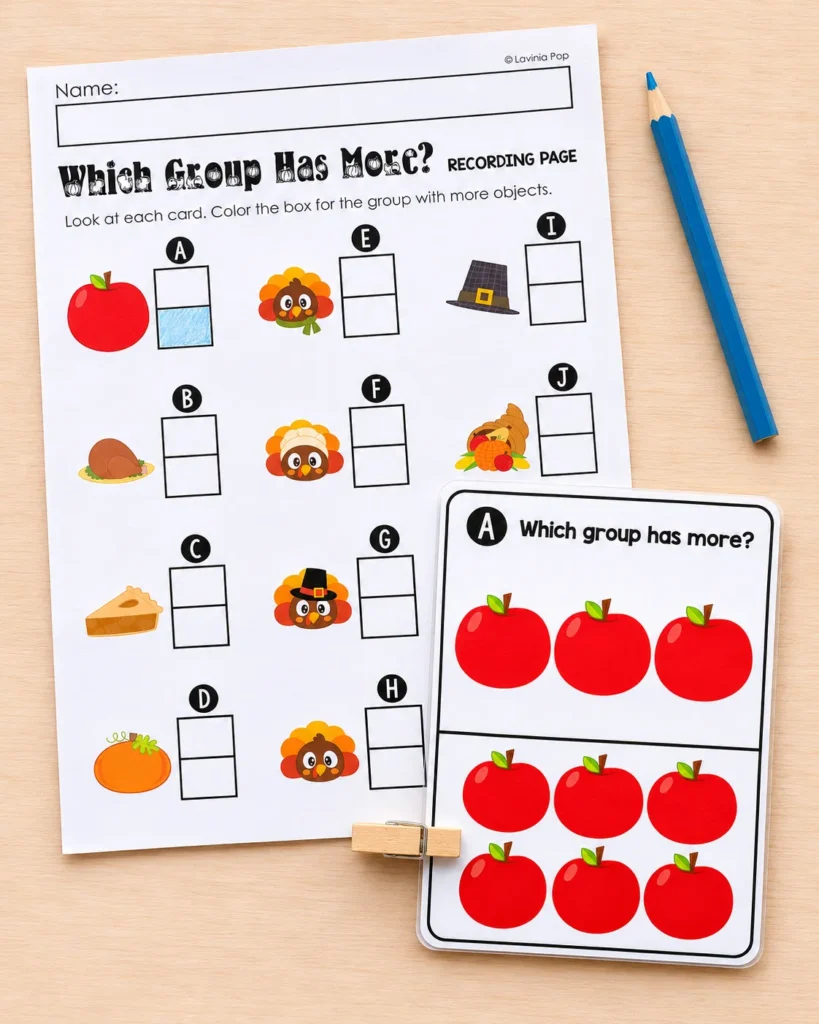
Children count the objects in both sections of a card and clip the group with more. On the recording page, they color the corresponding box to show their choice.
The apple card compares three apples with six apples. Ask children to explain how they checked which group had more.
Which Group Has Fewer?
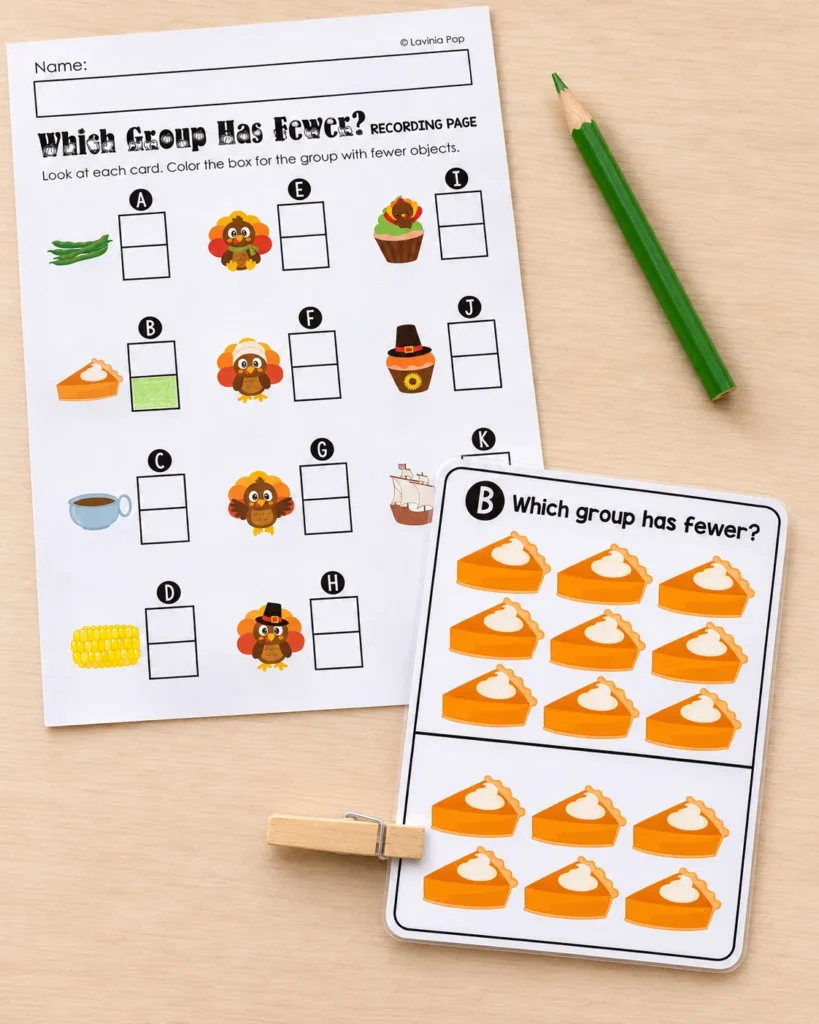
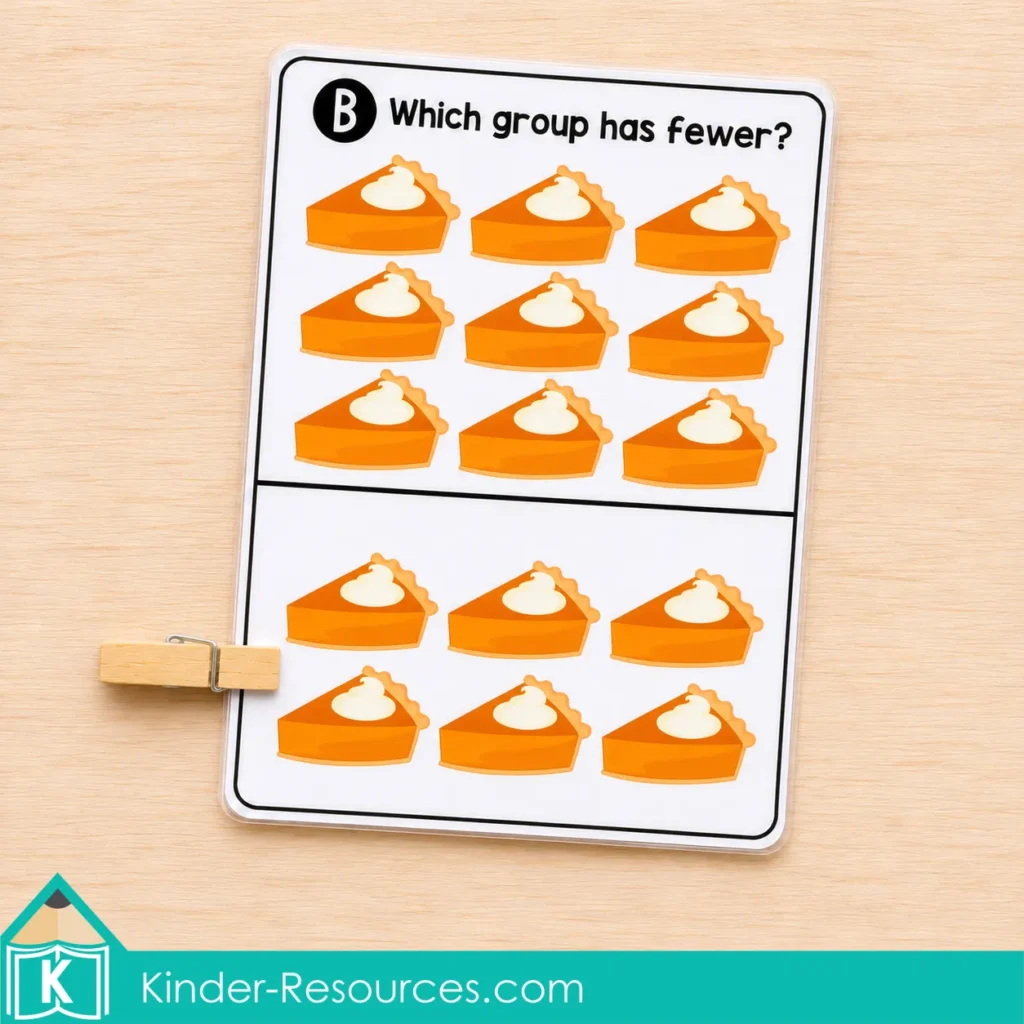
This activity follows the same routine, with children looking for the group with fewer objects. They clip their answer and color the matching box on the recording page.
The pumpkin pie card compares nine slices with six slices. Using both comparison activities gives children practice listening carefully to the words more and fewer.
Thanksgiving Count and Graph
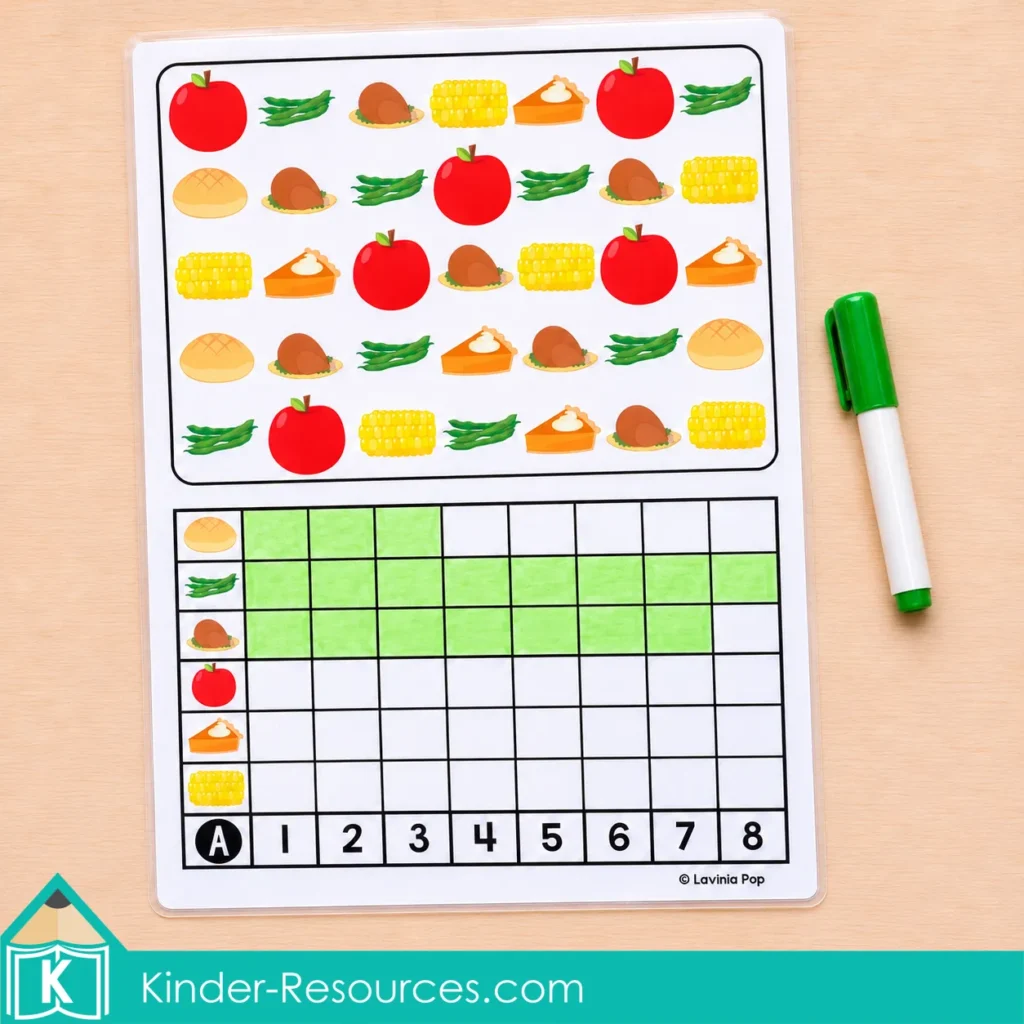
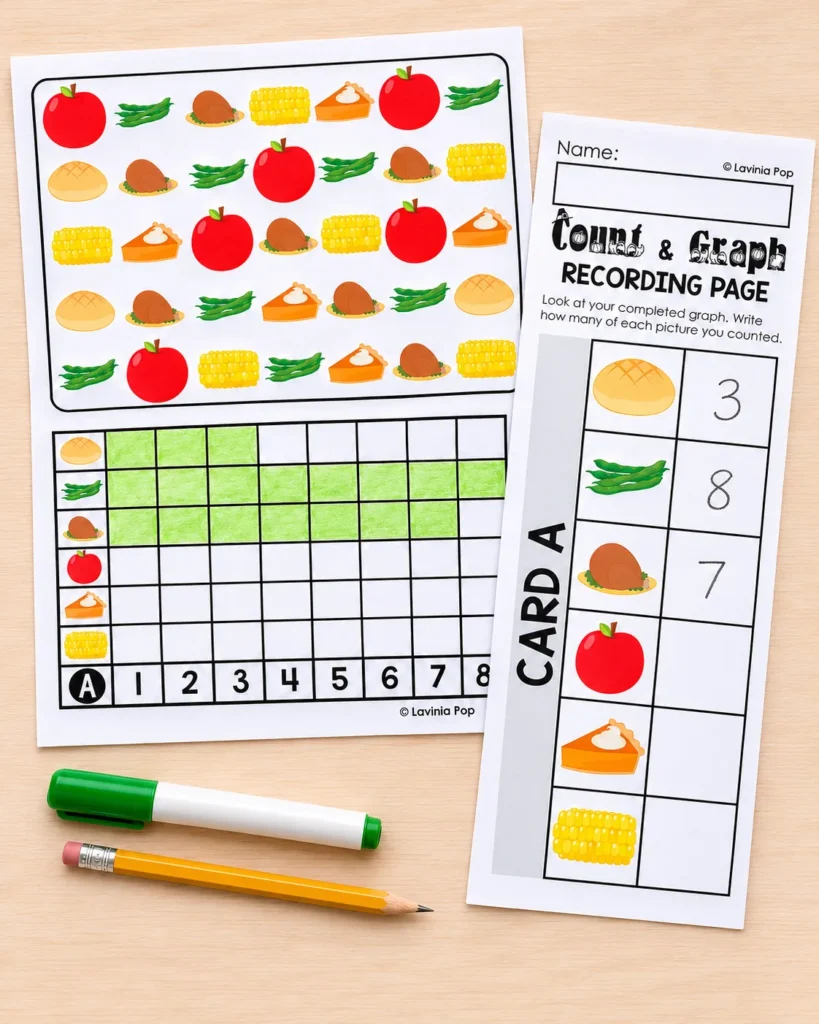
Children count each type of picture and color that many boxes in the matching graph row, starting beside the picture. The recording page provides space to write the totals.
Once the graph is complete, use it for a short discussion: Which food appears most often? Which appears least often? Do any foods have the same total?
Thanksgiving Math Centers: Addition, Patterns, and Skip Counting
Turkey Addition
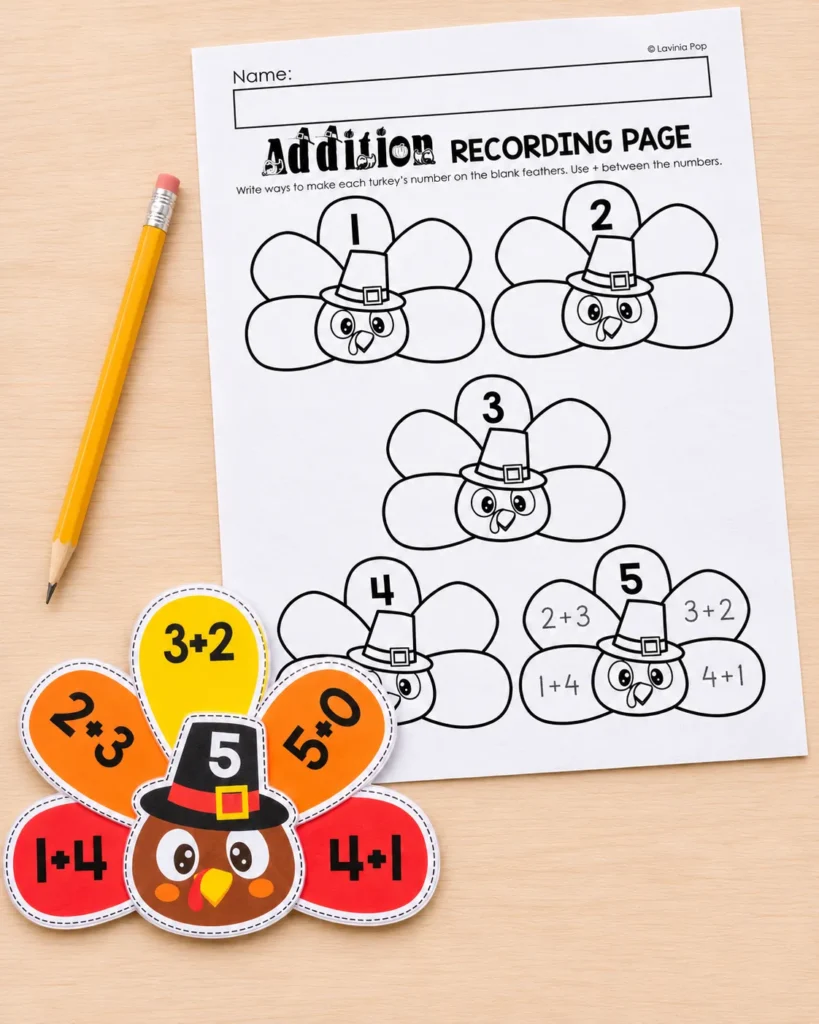
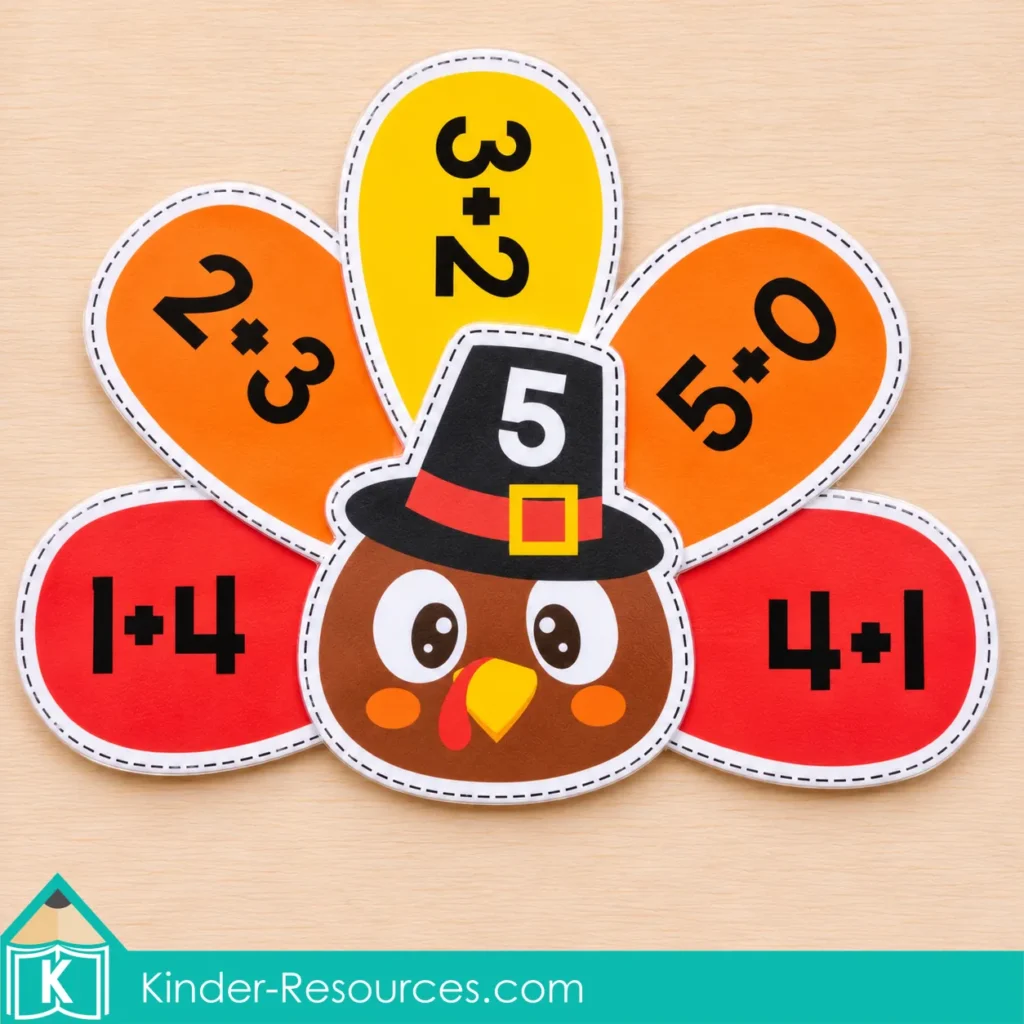
Children add the two numbers on a feather and match it to the turkey showing the answer. The activity includes totals up to 10, so you can select the sums that suit your group.
The recording pages let children write addition problems on the feathers. For example, a turkey labeled 5 can have feathers showing 2 + 3, 3 + 2, 1 + 4, and 4 + 1. Counters can help children model and check each combination.
Build a Thanksgiving Pattern
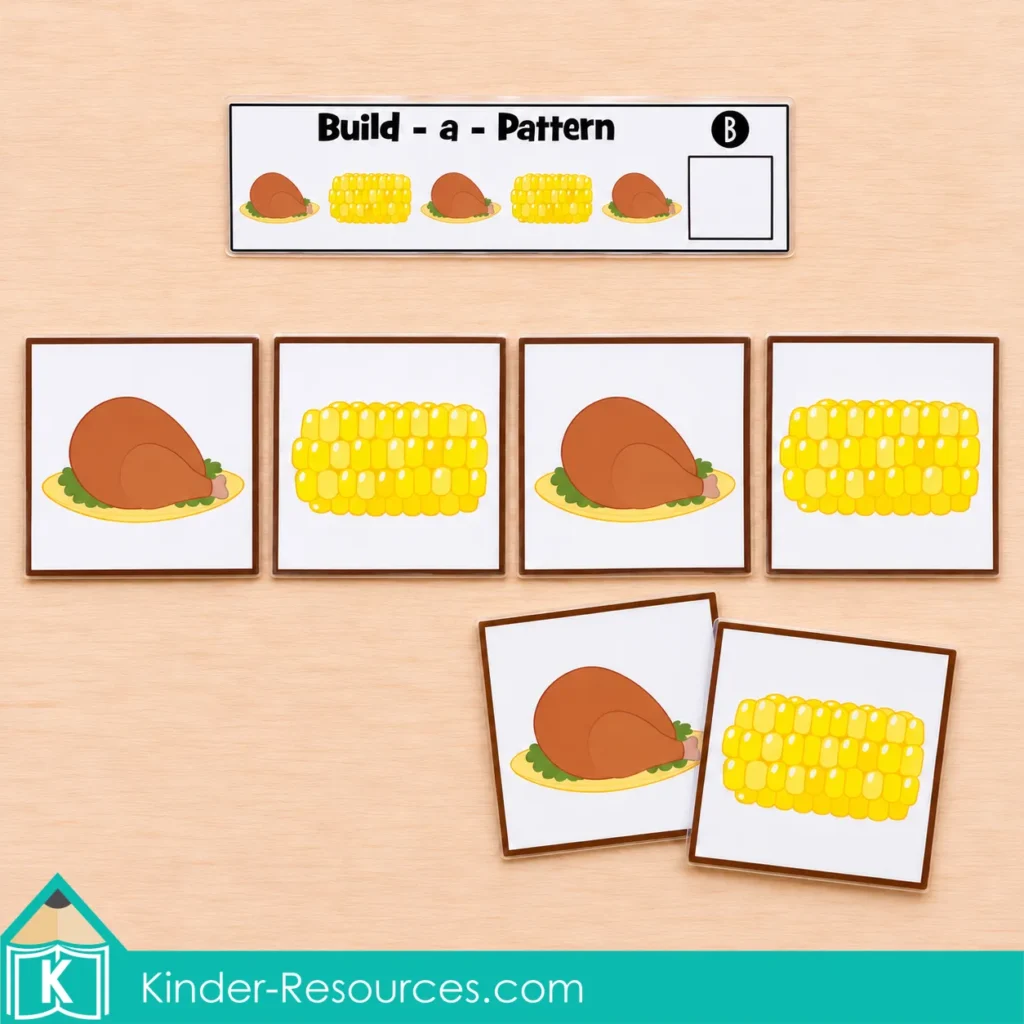
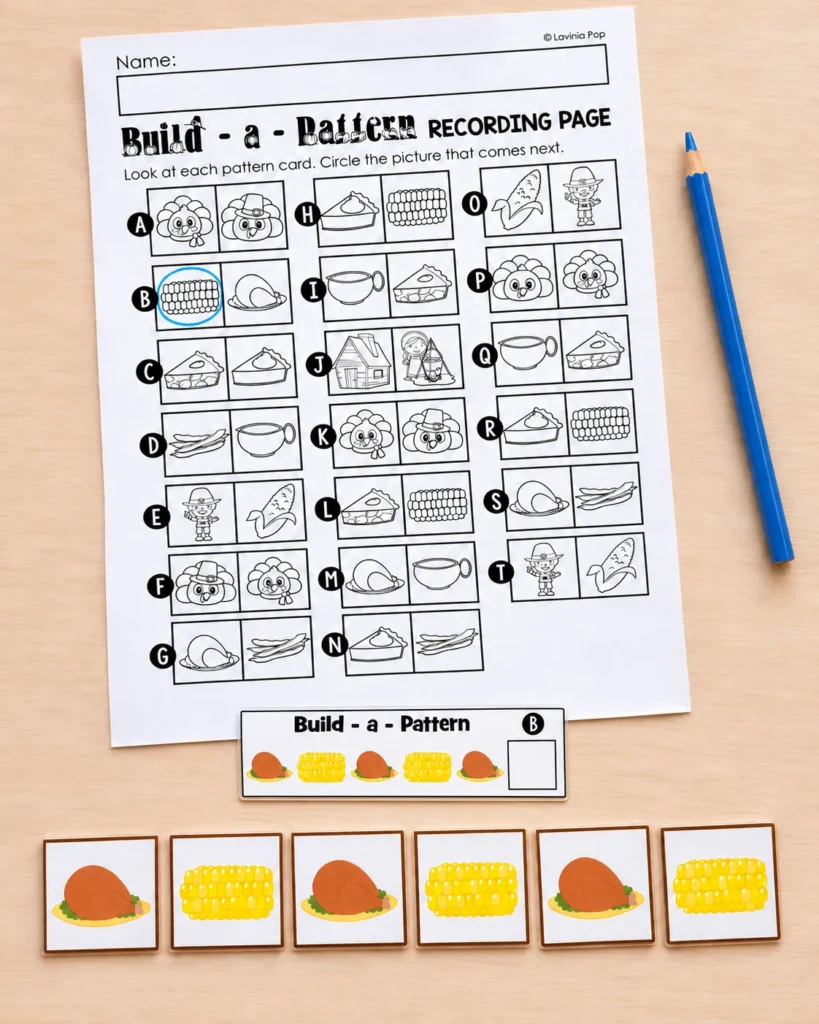
Children use the picture cards to copy a pattern and add the picture that comes next. The packet includes AB, ABB, AAB, and ABC patterns.
Saying the pattern aloud can help children hear the repeating part: “turkey, corn, turkey, corn.” On the recording page, they circle the picture that completes the pattern.
Thanksgiving Number Puzzles
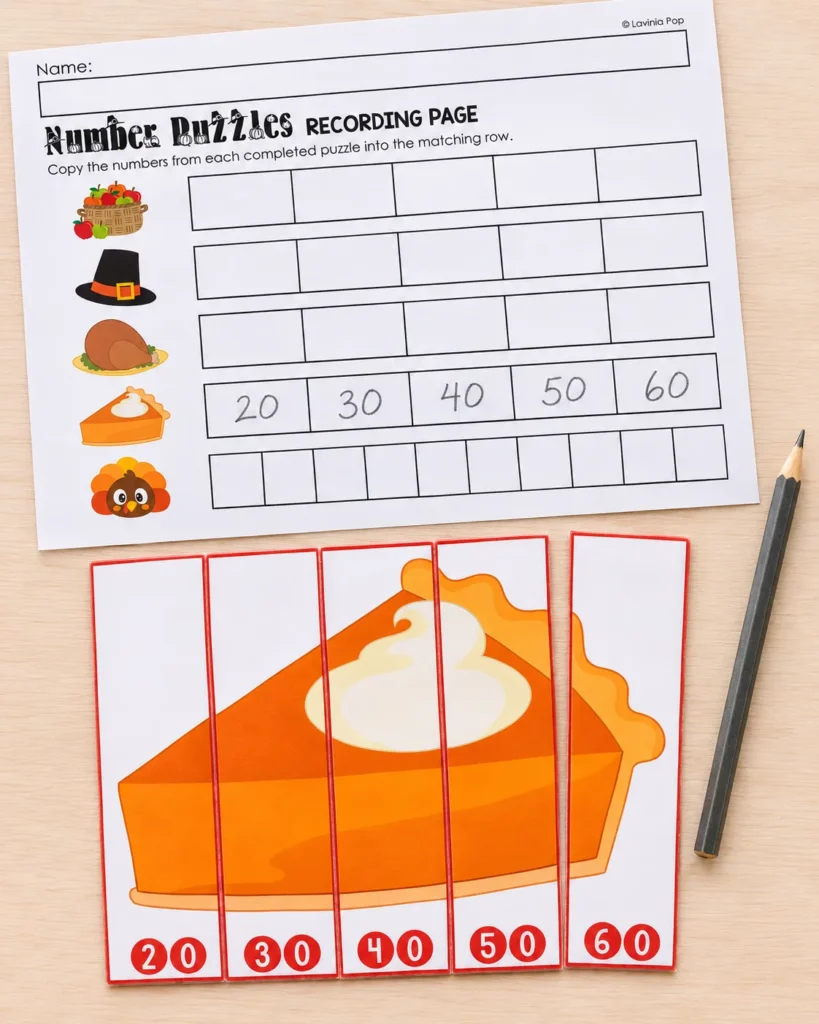
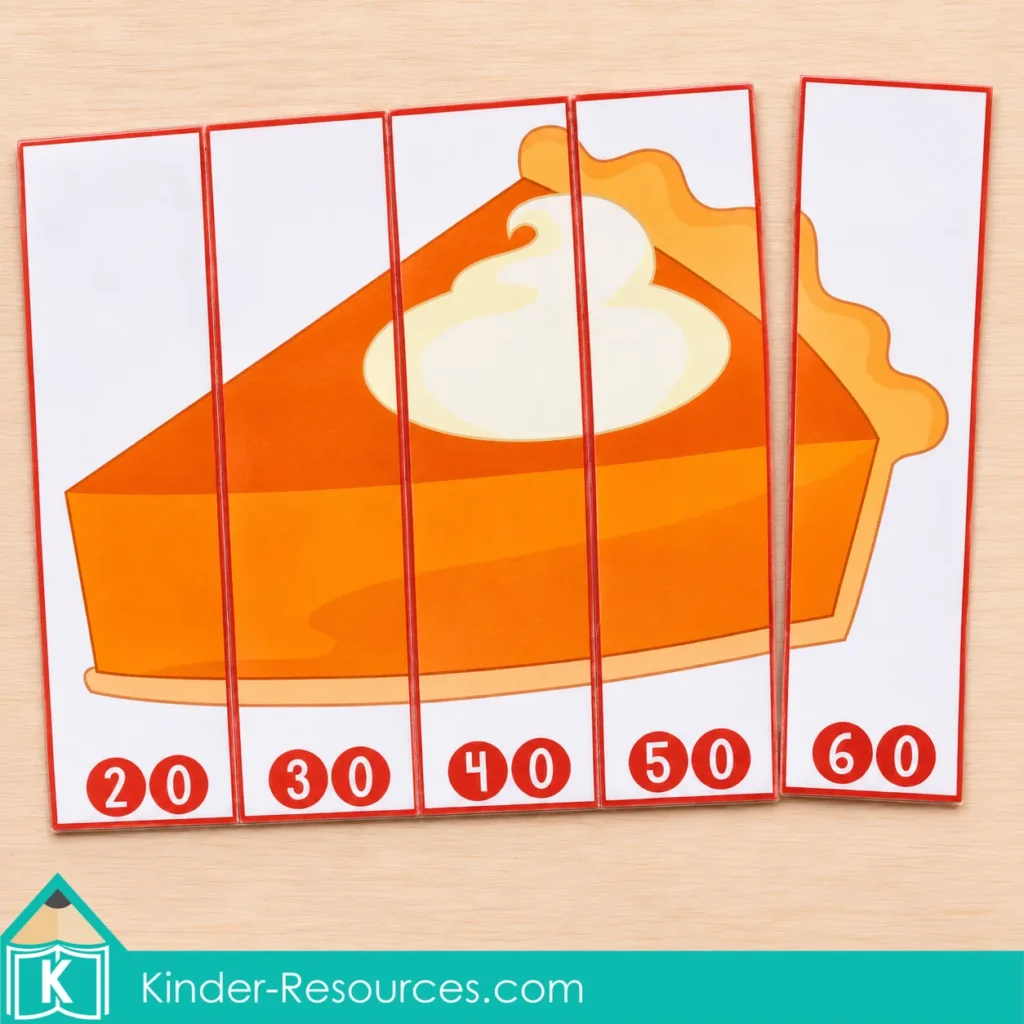
Children arrange numbered strips in order, counting by tens to reveal a Thanksgiving picture. The puzzles begin at different numbers, giving children practice with several sequences.
The pumpkin pie puzzle uses 20, 30, 40, 50, and 60. Children write the sequence beside the matching picture on the recording page. Introduce these puzzles when your group is ready to explore counting by tens.
Thanksgiving Math Centers: Shapes and Measurement Activities
Turkey Clip the Shape Cards
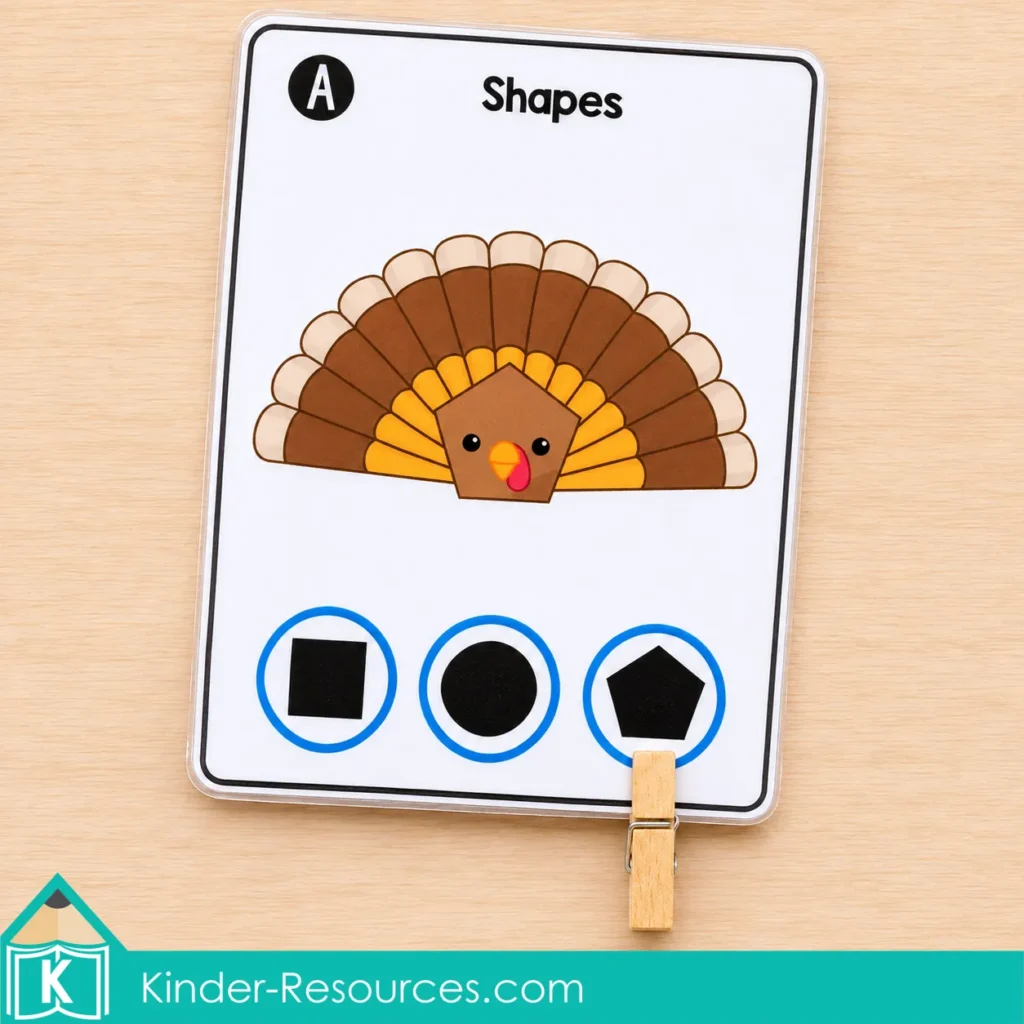
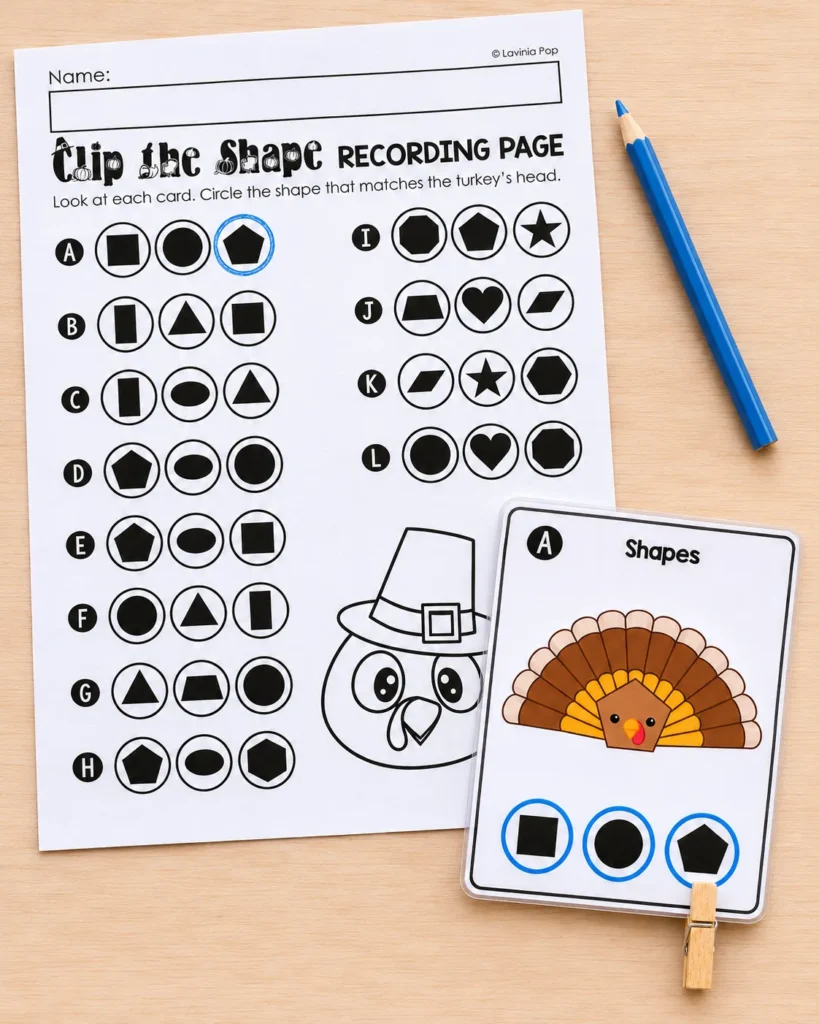
Children look closely at the shape of the turkey’s head and clip the matching shape below it. They then circle that shape on the recording page.
The example pictured features a pentagon. Invite children to describe what they notice about its sides and corners as they compare the choices.
Thanksgiving Nonstandard Measurement
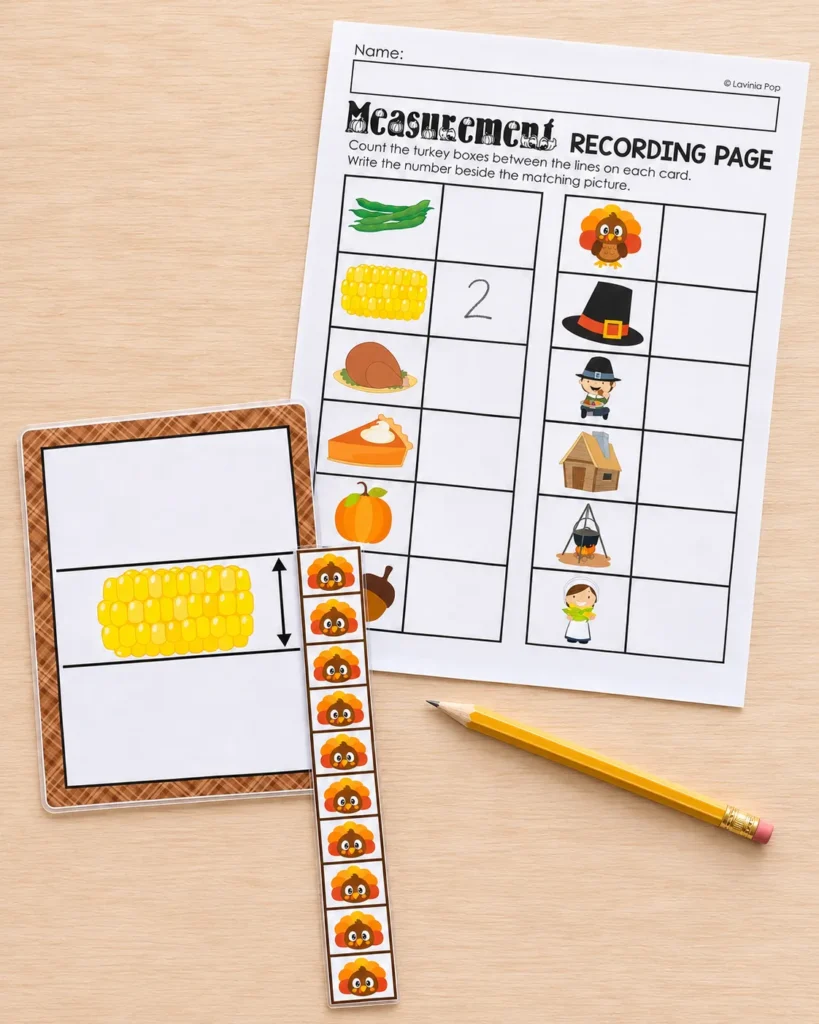
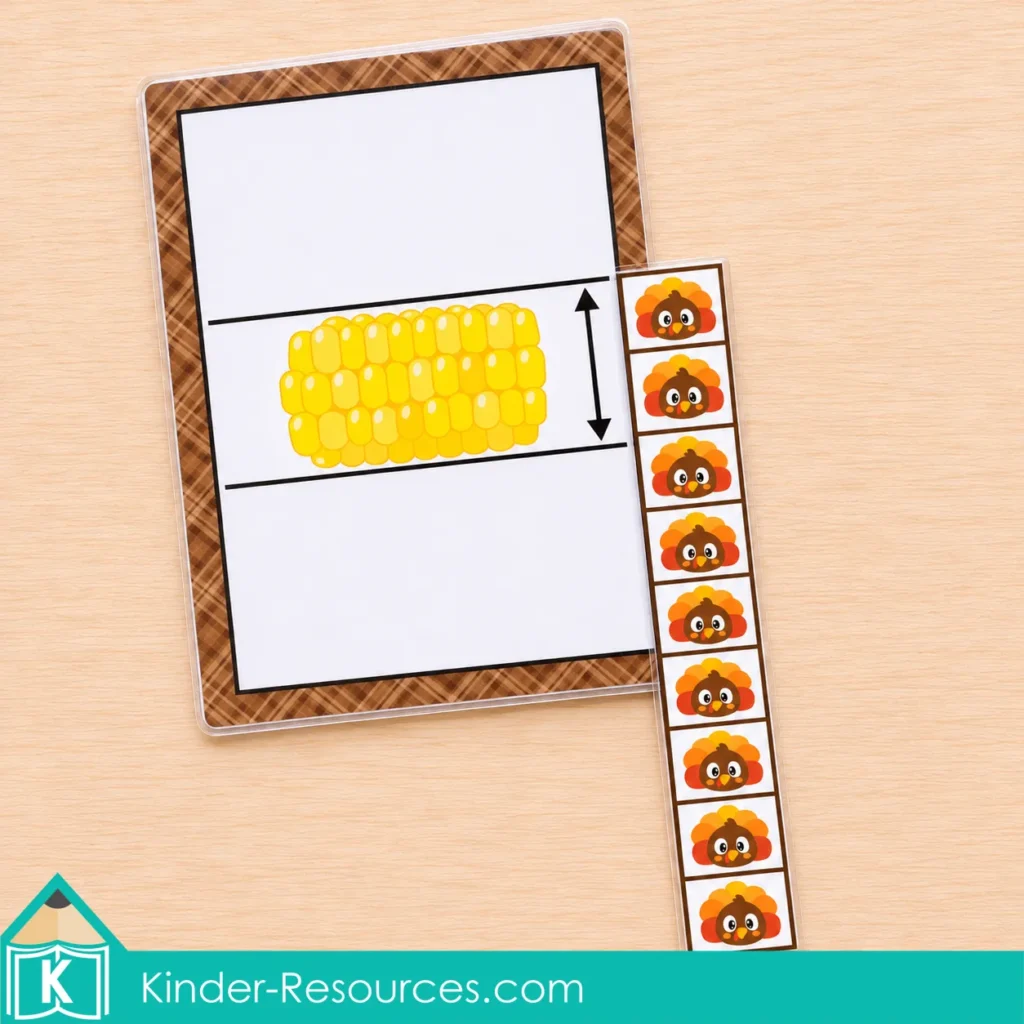
Children use the turkey measuring strip to measure the distance between the two lines on each picture card. They line up the top edge of the first turkey box with the upper line, then count the boxes down to the lower line.
They write their measurement beside the matching picture on the recording page. Print the cards and measuring strips at the same scale so the units line up correctly.
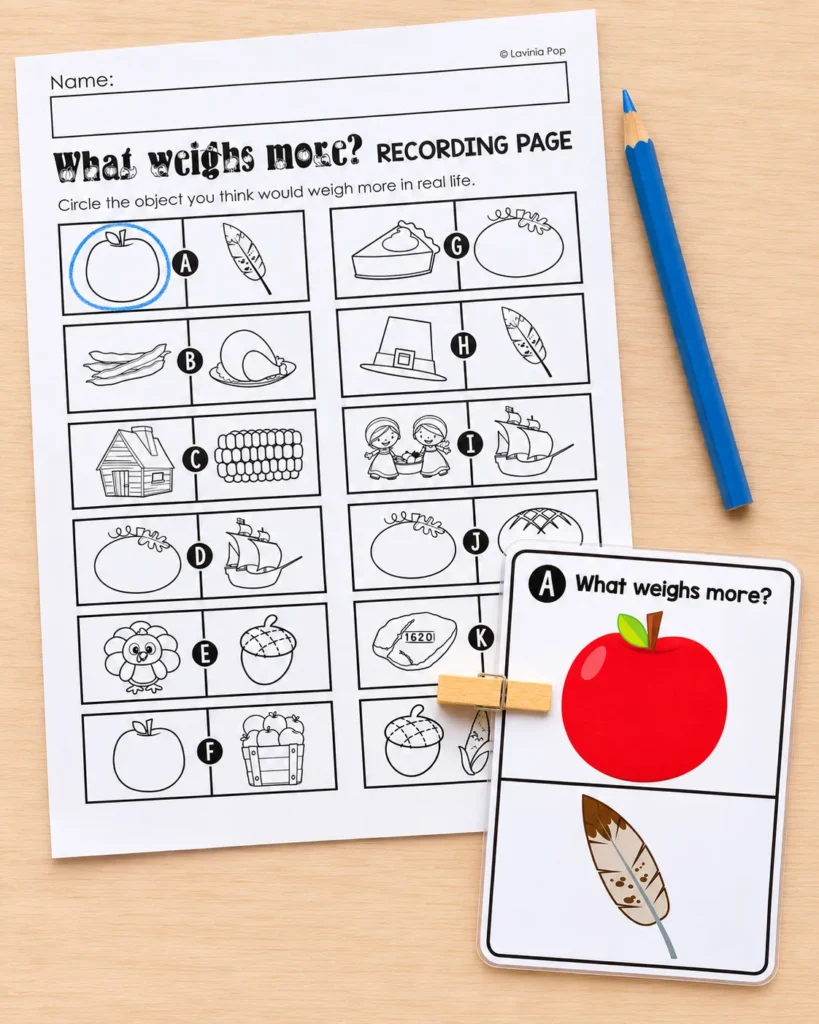
What Weighs More?
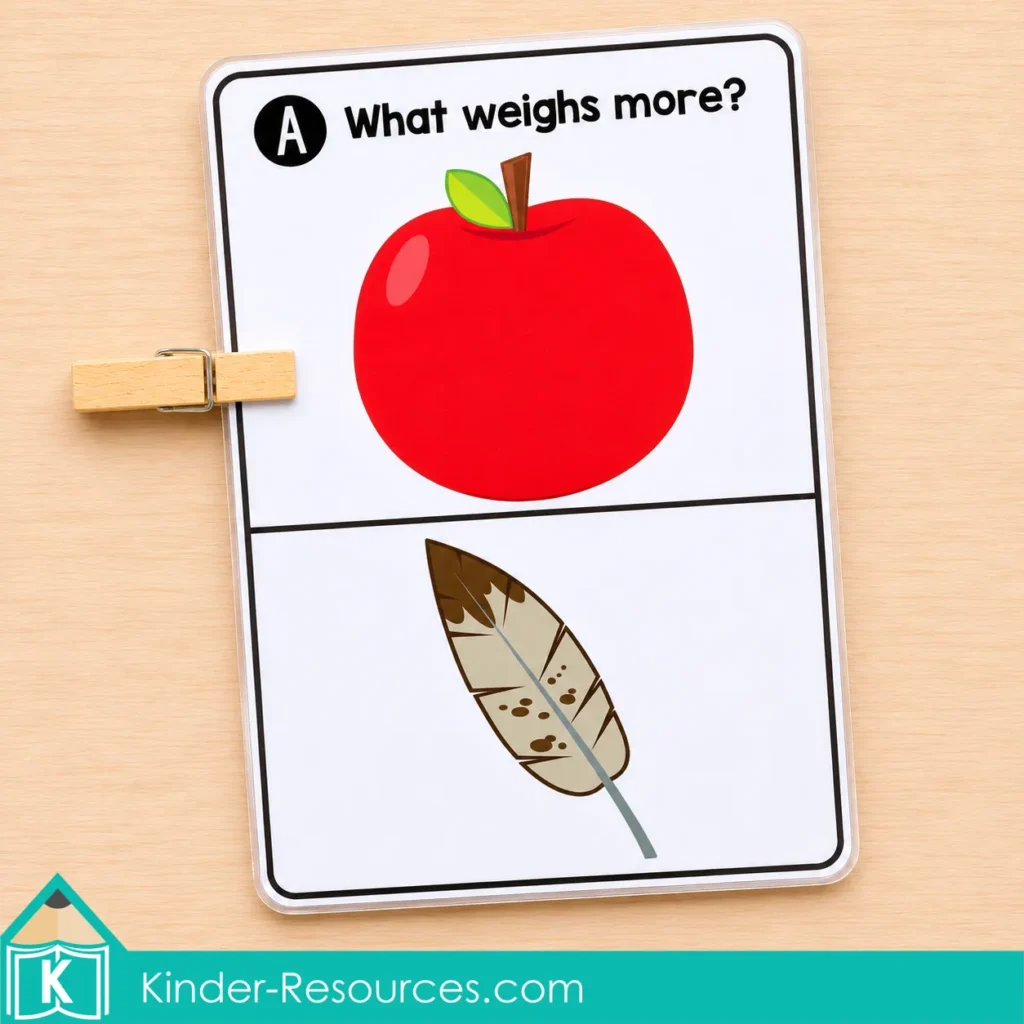
Children look at the two pictures and think about the objects in real life. They clip the object they think would weigh more, then circle their choice on the recording page.
Encourage children to explain their thinking. The apple-and-feather card is a useful starting point for discussing heavier and lighter. When suitable objects are available, children can check their predictions with a balance scale.
Thanksgiving Math Centers: Color Matching and Sorting
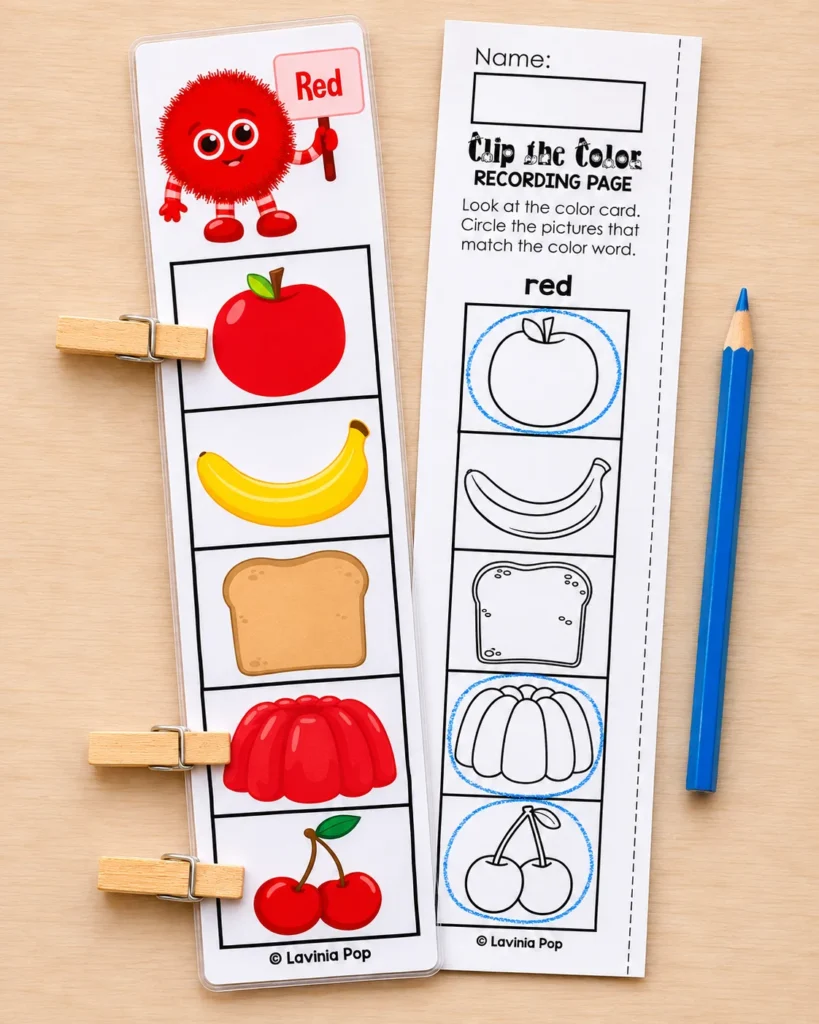
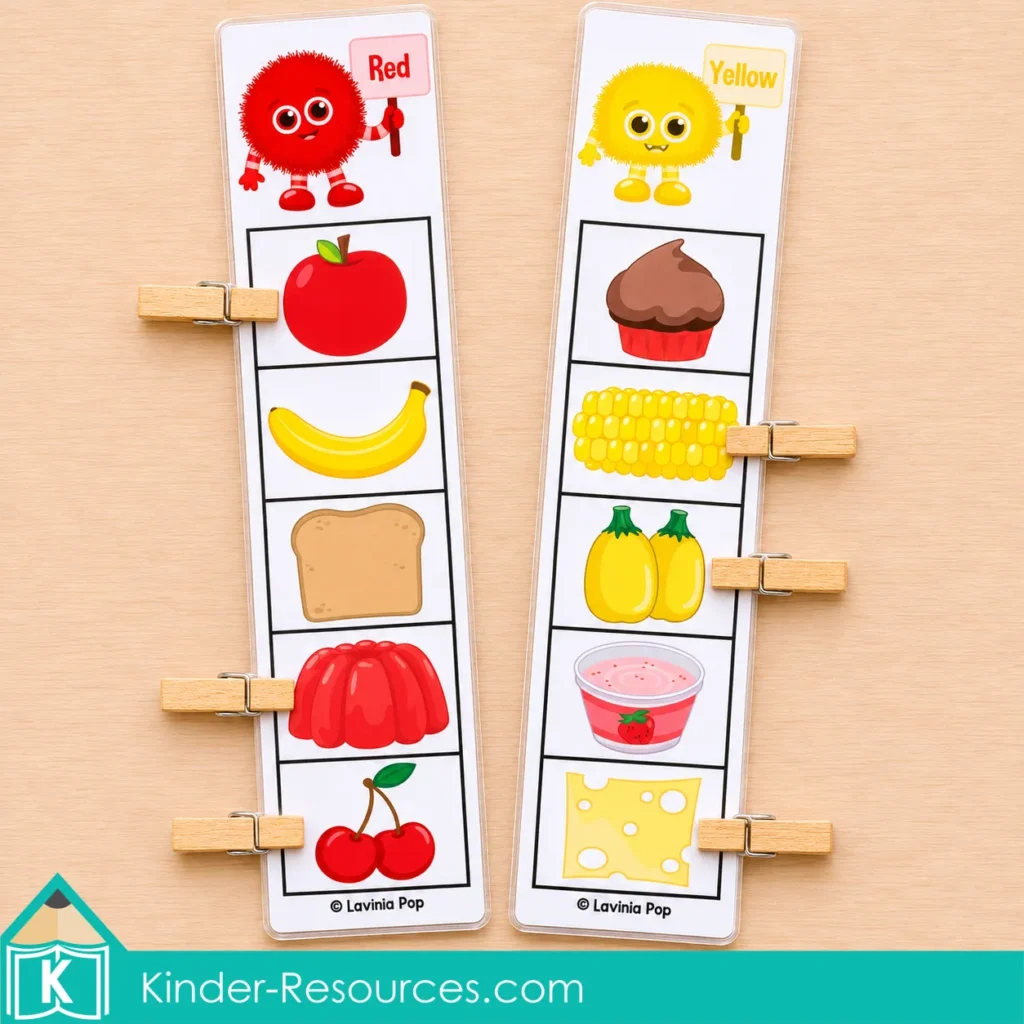
Thanksgiving Dinner Clip the Color
Children look at the color at the top of each strip and clip every food picture that matches. Some strips have several correct choices, so children need to check all the pictures.
They use the colored cards as a reference while circling matching foods on the recording page. On the red strip, the apple, jelly, and cherries all match.
Long Ago and Today Sorting
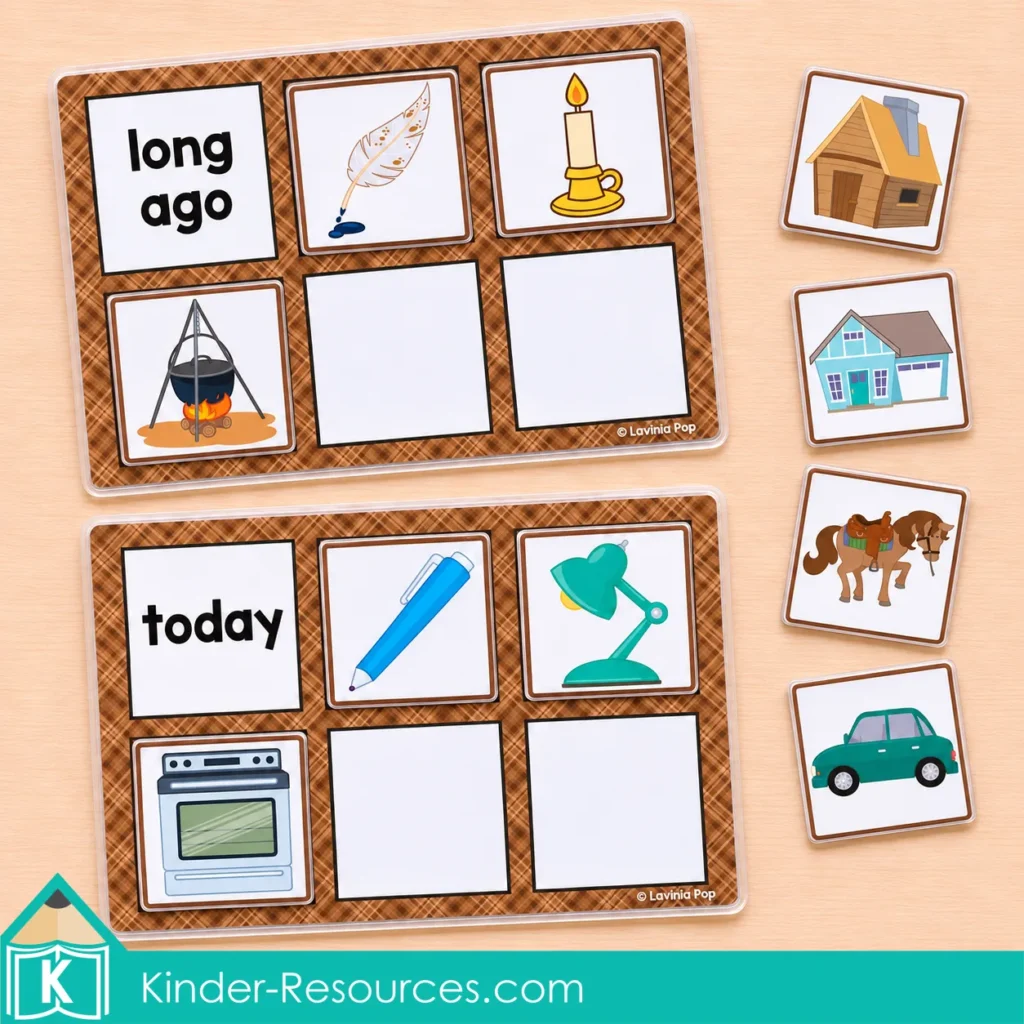
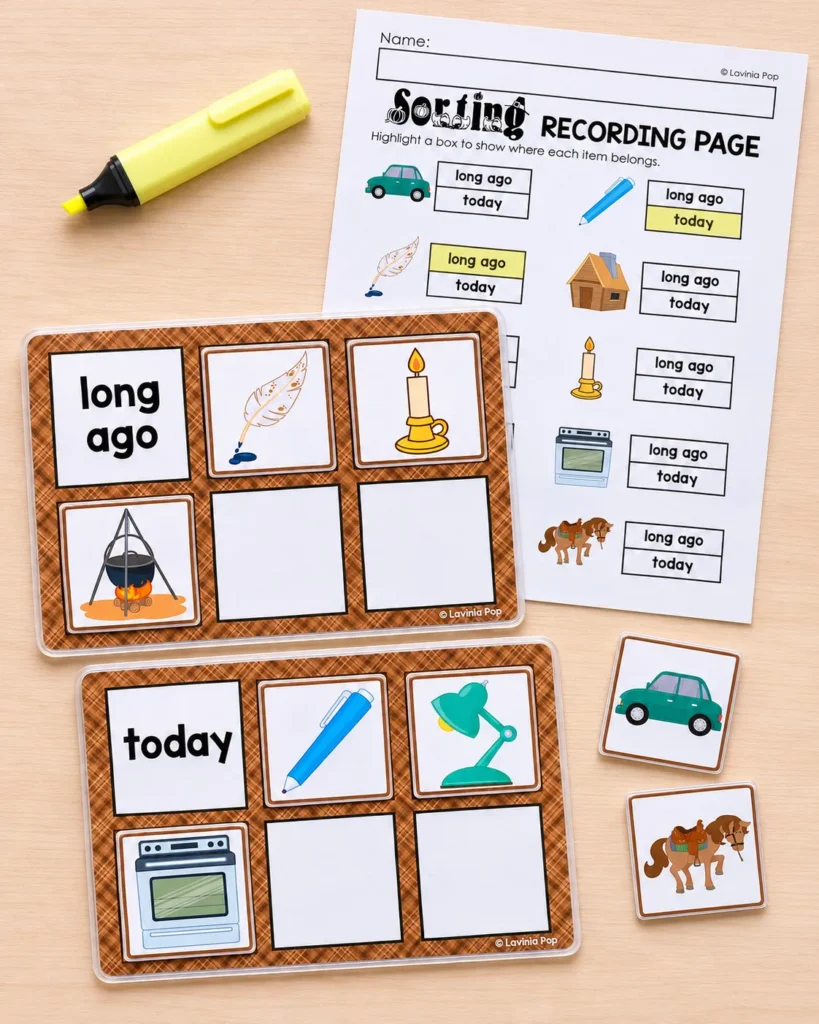
Children name the picture cards and sort them onto the “long ago” and “today” mats. Pictures include pairs such as a quill and pen, a candle and lamp, and a cooking pot over a fire and an oven.
This activity adds a social studies connection to the packet while giving children practice comparing and sorting. Talk about how people use the objects and how some older items are still used today. On the recording page, children highlight a box to show where each item belongs.
Using the Thanksgiving Math Centers Recording Pages
I’ve included recording pages for all 14 activities as an optional written follow-up. Children can complete them after the hands-on activity or during a separate session.
Match the amount of recording to your children’s readiness. You might ask children to complete a few selected responses, work with a partner, or explain their answers aloud before recording.
The partly completed pages in the photos show examples of how to respond. You can use the same approach when modeling an activity: complete one example together, then let children try the next one.
Choosing Thanksgiving Math Centers for Your Group
Select a few centers that match skills your children have already practiced. Counting and clipping, color matching, and simple AB patterns can provide familiar starting points. Add more challenging number sequences, addition combinations, or counting-by-tens puzzles when children are ready.
For extra support, offer fewer cards, use smaller quantities, and provide counters. To extend an activity, ask children to explain a match, create another pattern, or find a different addition combination for the same total.


Get the Complete Thanksgiving Math Centers for Kindergarten
The complete 121-page Thanksgiving Math Centers for Kindergarten packet includes all 14 activities, matching recording pages, illustrated “I can” cards, storage labels, and teacher directions.
Prepare the activities you need and rotate them through your November math centers, morning tubs, and small-group lessons.

Happy Teaching! 🙂
You Might Also Like


Nice web
is this a free printable>
Thank you for sharing.
You’re very welcome, Ruth! 😊